



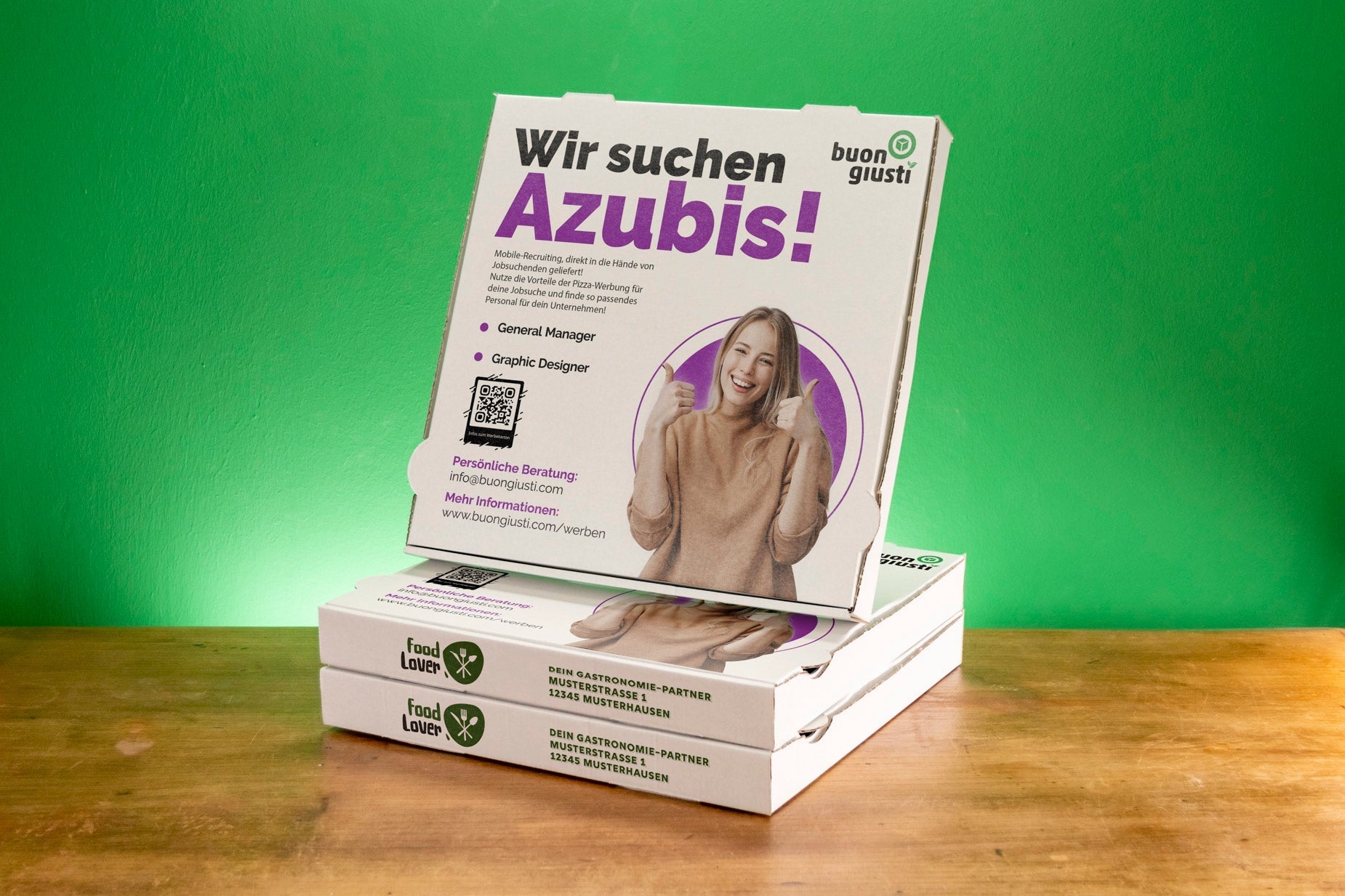
Friday evening, just after eight. The doorbell rings, the box is placed on the table, someone gets plates, and for the next half hour, this box is the center of the room. Everyone sits around it. Everyone looks at it. No one flips past.
There aren’t many advertising spaces in Germany that can honestly claim this. That’s exactly why the pizza box has developed from a curiosity into a serious channel for recruiting staff in recent years—not as a gimmick, but because it solves a problem that job ads and online campaigns increasingly fail to address.
This article explains how the channel works, which companies benefit from it, what should go on the box—and how to tell if it has worked.
Why job ads hit a limit
A job ad assumes something that is becoming increasingly rare: that someone is actively searching. Today, qualified people usually have a job, a decent salary, and no reason to open a job board in the evening. HR research calls this group “latent willing to change”—not on the market but approachable with a good offer. It is significantly larger than the group actively searching, and you simply can’t reach them through job portals.

The second way, paid reach on social networks, basically works—but it’s getting more expensive while attention is decreasing. A post in the feed competes with everything else in the feed. It’s a thumb swipe away from oblivion and disappears the moment the budget runs out.
Neither is an argument against job ads. They are arguments for complementing them—with a channel that reaches people where they are not on guard.
What advertising on pizza boxes really is
The model is a triangle, and it’s worth explaining openly because the price follows from it.
A catering business needs pizza boxes every day anyway. This is a fixed cost that brings in nothing. A company, on the other hand, is looking for staff exactly in the region where this business delivers. We bring both together: your design is printed on the boxes, the business receives them for free or at a steep discount, and in return, you get an advertising space of about thirty by thirty centimeters that is opened every evening in living rooms, offices, workshops, and break rooms.

Because the packaging is needed and paid for anyway, the medium carries differently than classic outdoor advertising. You don’t rent space – you occupy one that already exists.
Four reasons why the format sticks
The attention is undivided
There is no skip button, no ad blocker, and no banner blindness. The box lies open on the table, right in the middle of the action, and can’t be clicked away. Anyone who doesn’t want to read it has to actively look away.
The contact time is exceptionally long
An online ad fights for seconds. A meal takes time. Your message is in view the whole time – and it is not only seen but often read aloud, commented on, and passed on. Hardly any advertising medium naturally sparks a conversation like this.
The context rubs off
Advertising impact depends on the environment. Your message here is placed between after-work time, good food, and a relaxed gathering – not between two push notifications. This setting reflects on the sender, which is anything but insignificant when it comes to employers.
The distribution remains regional
A pizza box does not leave its delivery area. You don’t book anonymous surroundings but specific businesses – and thus exactly the streets from which your workforce already commutes. For employers tied to a location, this is perhaps the strongest point.
Who the channel is worthwhile for – and who it’s not
A good advisor also knows when to hold back. Advertising on pizza boxes plays to its strengths when these conditions come together:
- The demand is regional. You are looking for people who live within a reasonable distance – in production, crafts, logistics, care, administration, or gastronomy.
- The demand is recurring. You are not filling just one position but several regularly. Then repetition works in your favor.
- You are little known as an employer. Especially solid medium-sized companies without a consumer brand benefit the most here because they become visible in the first place.
- You provide training. The format is especially effective for apprenticeships: it reaches both young people and parents at the same table.
The channel is less suitable if you are filling a single, highly specialized position nationwide – a niche expert or a leadership role for which there may be only about five suitable people in the area. Direct approach is the better tool for that. Even for purely location-independent roles, you lose the biggest advantage of the medium.
What belongs on the box
The surface is large, the attention is there—and yet designs regularly fail for the same reasons. These points have proven effective in practice:
- One message, not five. A box is not a flyer. Whoever tries to fit seven positions, three benefits, and two QR codes loses everyone.
- Readable from two meters away. It’s read across the table, not with a magnifying glass. Large headline, high contrast, short lines.
- A real face. A photo from your own company beats any stock photo with a headset. People recognize the difference immediately.
- The reason, not just the position. “Industrial mechanic wanted” is information. “Four-day week, fixed early shift, 15 minutes from here” is a reason.
- A method that works on the couch. People scanning in the evening don’t have a cover letter at hand. Lead to a mobile form, not a PDF process.
- No internal job titles. What your system calls “Specialist Intralogistics Level 2” is not searched for outside.
Three mistakes we keep seeing
The job ad is copied one-to-one. A job ad text is written for someone already searching. On the box, people are thinking about everything else. The first sentence must generate interest, not list requirements.
The QR code leads to the homepage. Anyone who scans and then has to click through a career menu is gone. Create a dedicated landing page that shows exactly the advertised position—it takes an hour and saves half the campaign.
Too few copies in too large an area. Recognition is created through repetition. Ten businesses in one city have more impact than fifty boxes in fifty locations. Better deep than broad.
How to measure if it works
The most common objection in marketing departments is: Offline cannot be measured. That’s not true—you just have to set up the measurement beforehand.
- Your own target URL with UTM parameters behind the QR code. This way, you can clearly see visits, dwell time, and submitted applications separately from your other channels.
- Your own phone number or email address for those who prefer to call directly. This group is larger than online reports suggest.
- The question in the application form: "How did you hear about us?" A mandatory field, one click, lasting insight.
- The right time frame. A circulation is distributed over weeks, not a weekend. Evaluate after the full run, not after three days.
Then compare the result against your previous cost per application. That is the only comparison that matters – and the only one your management wants to see.
How a campaign runs
The organizational effort on your side is manageable. Usually, there are four steps: In the first conversation, we clarify target group, region, and circulation – this rarely takes longer than twenty minutes. Then the design is created, either from your templates or entirely by us, until you approve it. After that, the circulation goes to print, and the selected gastronomy businesses receive the boxes and pass them on with every order. Usually, only a few days pass between approval and the first delivered batch – fast enough to respond to a specific staffing need.
We basically need three things from you: logo and colors, the position in question, and approval. Design, partner selection, production, and logistics are handled by us. Printing is done on food-safe, recyclable cardboard.
The box makes a bella figura
In Italy, there is a word for what this is really about: bella figura – the good impression you make without forcing it. No noise, no superlatives, just a clean appearance at the right moment.
That is exactly the opportunity of this format. Your company does not appear as a supplicant in an overcrowded job board but as a natural part of a good evening. And if someone reads on Friday while eating that twelve minutes away someone is needed who can do exactly what they do all day – they will think differently about their work on Monday.
How such a campaign is specifically structured, which regions can be covered, and what should be on your design, you can read on our page about Advertising on Pizza Boxes. If you are already in the gastronomy business and want to use your own space, you can also find packaging with logo with us.
Find staff where others’ ads get skipped
Tell us the region and positions you are looking for – you will receive an estimate of circulation, costs, and schedule.
Request campaign without obligation →


